How to Build a Scalable Cybersecurity Assurance Program in 2026
A Practical Guide for CISOs, Security, GRC, and Revenue Leaders
Cybersecurity assurance has quietly become one of the most critical — and most strained — functions inside modern organizations.
In 2026, enterprises aren’t just buying products. They’re buying trust. They want proof that their data, their customers’ data, and increasingly their AI-driven workflows are secure, governed, and responsibly managed. And they want that proof fast.
Yet many organizations are still relying on manual, fragmented, and people-dependent assurance processes that simply don’t scale. The result? Slower deals, burned-out security teams, and growth bottlenecks that have nothing to do with product quality.
This guide breaks down what security assurance really is, why it’s now a growth-critical function, and how security leaders can build a program that scales with the business—not against it.
What is Cybersecurity Assurance?
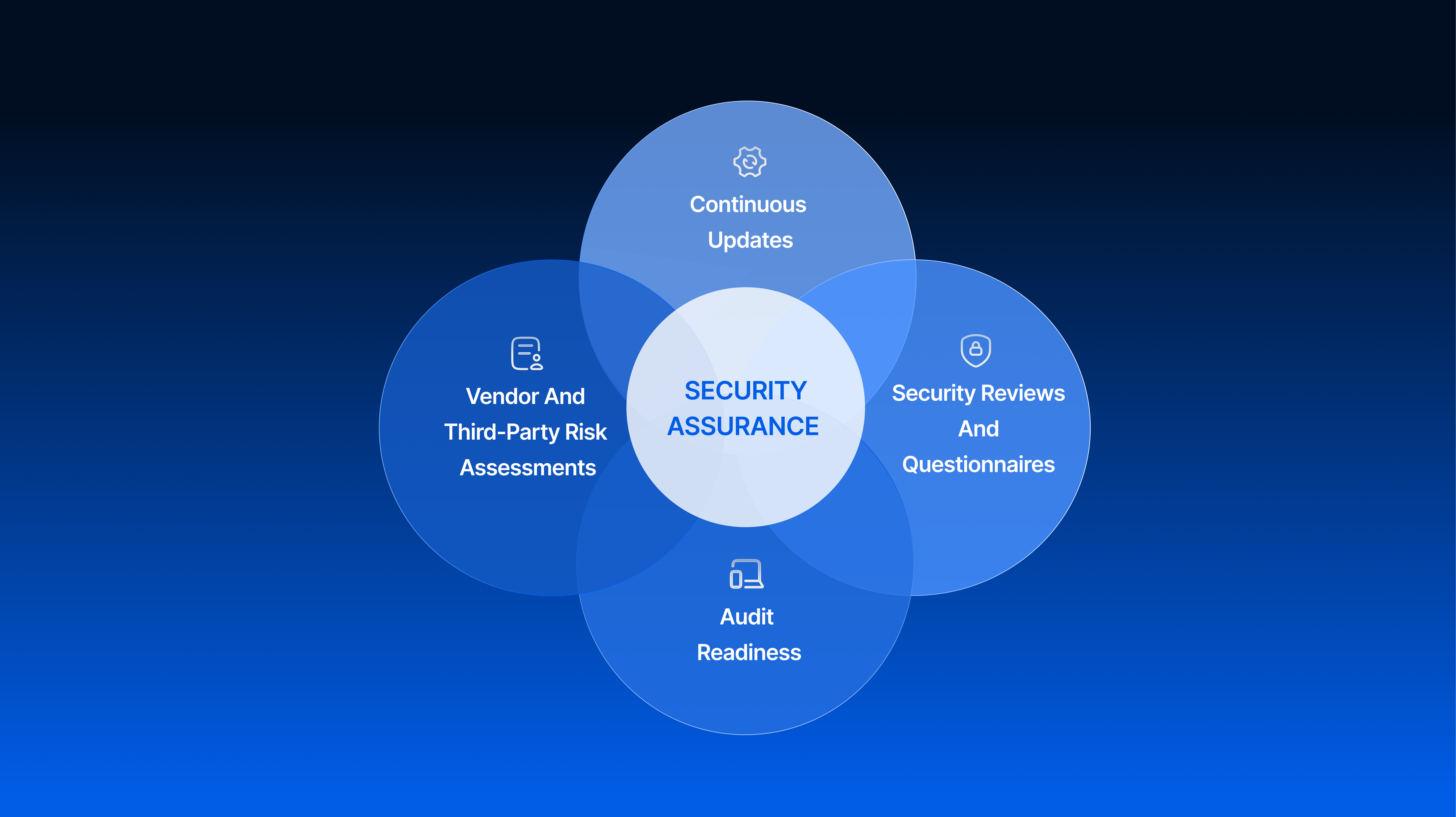
Cybersecurity assurance is the ongoing process of demonstrating an organization’s security, privacy, and compliance posture to customers, partners, and vendors — through evidence, documentation, and verification.
It goes beyond passing audits or checking compliance boxes. Security assurance is about consistently answering one fundamental question: Can you prove — clearly, accurately, and repeatedly — that your organization is trustworthy?t
Security assurance includes:
- Customer-facing security reviews and questionnaires (sell-side assurance)
- Vendor and third-party risk assessments (buy-side assurance)
- Evidence management, policy alignment, and audit readiness
- Continuous updates as products, regulations, and risks evolve
In practice, it’s one of the most visible expressions of a company’s security maturity.
Who own security assurance
Security assurance is often treated as a security team responsibility — but in reality, it’s a shared, cross-functional effort.
- Security — Owns technical controls, security architecture, risk posture, and evidence.
- GRC (Governance, Risk, and Compliance) — Maps controls to frameworks, regulatory requirements, and audits, ensuring consistency and traceability.
- Legal and Privacy — Oversees data processing commitments, contractual assurances, privacy obligations, and AI-related legal risk.
- Sales and Revenue — Operate on the front lines with customers, where security assurance directly affects deal velocity and win rates.
- Product and Engineering — Drive changes to architecture, features, and AI models — changes that must be reflected accurately in assurance responses.
Key insight: Security assurance fails when teams operate in silos. It succeeds when collaboration is built into the process.
How cybersecurity assurance impacts revenue and growth
Security and compliance have become primary buying criteria for enterprise customers — and this trend is accelerating with the rapid adoption of AI.
Customers want to know:
- How their data is protected
- How vendors manage third-party risk
- How AI systems are governed and monitored
- How quickly and transparently security questions can be answered
When security assurance doesn’t scale, deals stall during security reviews, sales teams lose momentum, security teams become bottlenecks instead of enablers, and high-value opportunities quietly disappear.
Conversely, organizations with strong, scalable assurance programs:
- Move through security reviews faster
- Build trust earlier in the sales cycle
- Differentiate in crowded markets
- Turn security into a competitive advantage
Common blockers to scaling a security assurance program
Scaling cybersecurity assurance is challenging because it sits at the intersection of people, processes, and technology.
Operational Challenges
- Limited bandwidth across Security and GRC teams
- Tribal knowledge locked in individual inboxes or Slack threads
- Manual handling of security questionnaires and evidence requests
Organizational Challenges
- Poor collaboration between Security and Sales
- Misaligned incentives between risk reduction and revenue growth
- No single source of truth for security information
Technology Challenges
- Point solutions that can’t adapt to new regulations, product and architecture changes, and AI-driven use cases
- AI-only automation that lacks context, nuance, or human validation
Volume & Seasonality Challenges
- Quarterly and annual spikes in security reviews
- Vendor renewals, audits, and customer reviews hitting simultaneously
- No way to flex capacity without hiring or burning out teams
What a scalable security assurance program requires in 2026
Creating a scalable program requires both strategic vision and practical infrastructure. It’s about designing processes and tools that work continuously, not just in bursts.
A few elements are critical:
- A living security knowledge base. This centralized resource should be continuously updated, mapped to regulations, frameworks, and products, and structured for reuse. It ensures teams never have to reinvent the wheel and maintains consistency across responses.
- Automation with human oversight. Automation handles repetitive tasks, while humans manage nuance, exceptions, and judgment calls. This combination maximizes efficiency without sacrificing accuracy.
- Self-service trust centers. Providing customers with on-demand access to certifications, policies, and high-level architecture details reduces the volume of incoming requests and builds transparency.
- Unified buy-side and sell-side workflows. By consolidating security questionnaires and third-party risk assessments into a single platform, teams can leverage shared evidence and streamline operations.
- Scalable capacity for peak seasons. The system should handle surges in demand without requiring emergency hiring or causing burnout.
Each of these components works together to create a resilient, efficient, and growth-oriented assurance program.
How AI changes (and complicates) security assurance
AI adoption introduces entirely new dimensions to security assurance. Customers and vendors now ask:
- How are AI models trained and monitored?
- What data sources are used, and how is privacy protected?
- How do you manage risks like model drift or misuse?
Legacy tools and static templates are ill-equipped for these questions. AI requires context-aware systems that can evolve alongside technology, ensuring that assurance keeps pace with innovation rather than lagging behind.
Build vs buy? The path to scalable assurance
Many organizations attempt to cobble together workflows with spreadsheets, ticketing systems, and shared drives. While this might work at a small scale, it quickly becomes brittle, inefficient, and costly to maintain.
Purpose-built assurance management platforms, on the other hand, offer built-in scalability, workflow automation, and continuous updates, allowing teams to focus on judgment and strategic impact rather than manual tracking.
How SecurityPal Enables Truly Scalable Security Assurance
SecurityPal’s Assurance Management platform (AMP) addresses the scale challenge head-on — ensuring that security teams can operate efficiently, accurately, and confidently, even as demands spike or new AI-driven risks emerge.
- Centralized assurance management
- Automation and human expertise
- Unified customer and vendor assurance
- Designed for real-world scale and AI-era complexity
It’s a system built not just to keep pace with 2026 realities — but to turn security assurance into a strategic differentiator for the business.
FAQ
What is a cybersecurity assurance program?
A cybersecurity assurance program formalizes how an organization demonstrates its security, privacy, and compliance posture to customers and vendors on an ongoing basis.
Who is responsible for security assurance?
Security assurance is a shared responsibility across Security, GRC, Legal, Sales, and Product teams.
How does security assurance impact revenue?
Scalable assurance reduces sales friction, accelerates deal cycles, and increases enterprise trust.
How is security assurance different from compliance?
Compliance focuses on meeting specific standards; security assurance focuses on continuously proving trustworthiness to stakeholders.
How does AI affect security assurance?
AI introduces new risks, questions, and expectations that require more dynamic, context-aware assurance processes.
Security Assurance as a Competitive Advantage
Security assurance is no longer optional. In 2026, scale is the difference between growth and gridlock.
Organizations that invest in scalable assurance programs move faster, build trust earlier, and operate with resilience in an increasingly complex risk landscape. With the right foundation, security assurance becomes more than a requirement — it becomes a strategic advantage.
Explore how SecurityPal’s Assurance Management Platform streamlines customer and vendor reviews, automates workflows, and keeps your team ahead of evolving risks.


.webp)