Security Questionnaires Are Now Pre-Sales: What This Means for Revenue Teams
What the 2026 Assurance Insights Report reveals about security's growing role in the sales cycle.
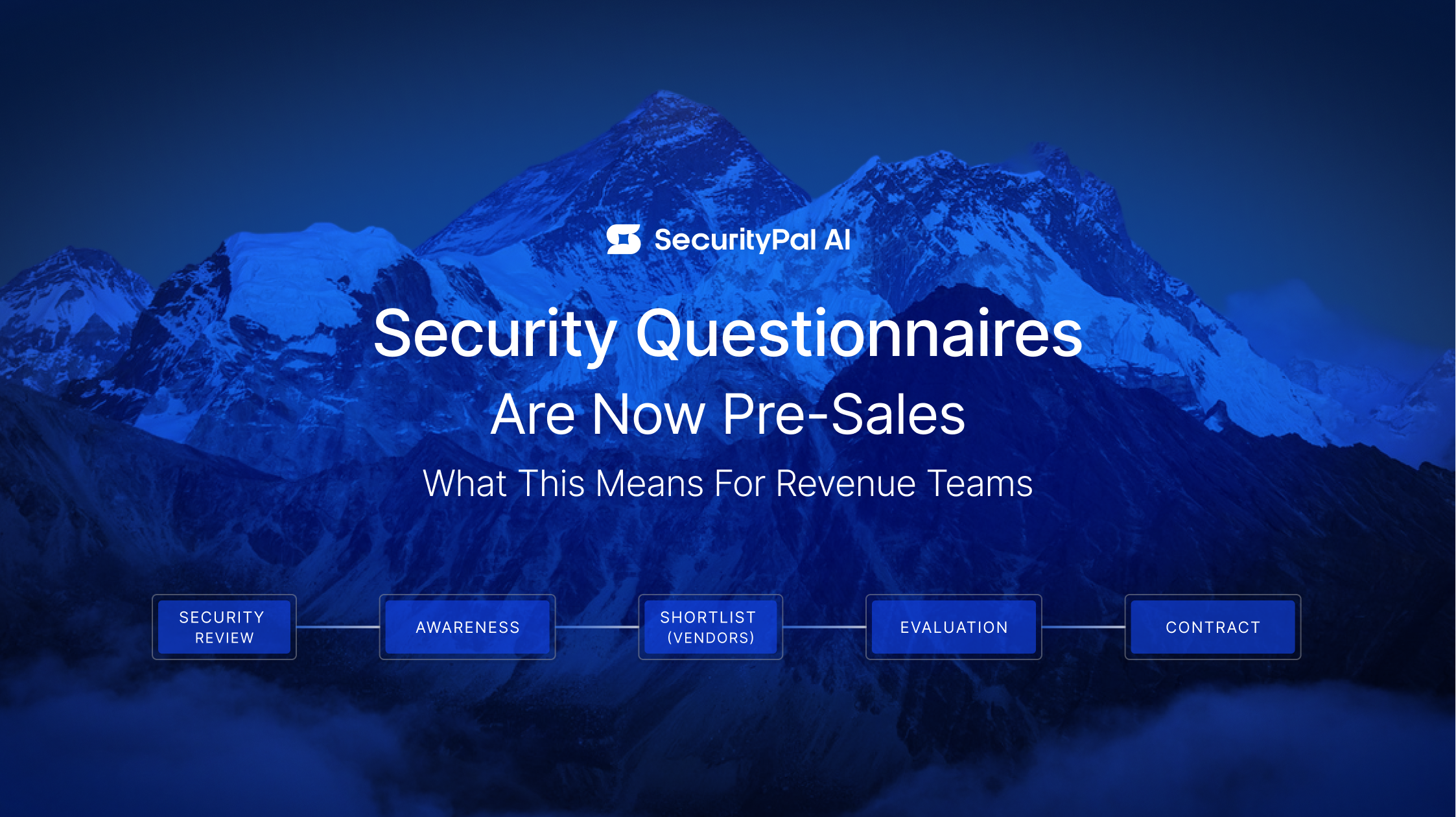
Security questionnaires used to be a stopgate. They showed up late in the sales cycle, after demos and negotiations, serving as a final checkbox to confirm that a vendor met baseline security and compliance requirements.
However, the rapid expansion of AI, paired with an explosion in software and integrations, has fundamentally reshaped the security landscape. Every new tool, copilot, and workflow introduces new risk, and buyers are responding accordingly.
Security reviews have evolved from an administrative hurdle into a core business differentiator.
In our 2026 Assurance Insights Report, we analyzed data from thousands of real-world security reviews across SecurityPal’s platform. Not surveys. Not opinions. Actual buyer behavior.
What we found is clear: Security is no longer just risk mitigation. It’s pipeline influence.
If security shows up before your product does, it’s no longer a back-office function. It’s part of your go-to-market motion.
The Data: Security Reviews Are Entering the Funnel Earlier
Trend #1: Questionnaires Are Showing Up Before Shortlisting
Security questionnaires are increasingly appearing at the very beginning of the buying journey, often before vendors are even shortlisted.
This is a significant departure from the traditional model, where questionnaires were sent just before contract signature.
Today, buyers are:
- Using security to filter vendors earlier
- Sending questionnaires at higher volumes in early-stage evaluation
- Making go/no-go decisions before a full sales process even begins
What this signals:
You’re being evaluated on security before you’re even fully selling. Security is no longer a step to close. It’s a gate to entry.
Trend #2: Questionnaires Now Look Like Pre-Sales RFPs
Security questionnaires aren’t just arriving earlier. They’re also getting more complex.
More and more, they resemble pre-sales RFPs, blending:
- Security controls
- Product architecture
- AI usage and governance
- Data handling practices
- Differentiation and design decisions
What this signals:
It’s not just about security anymore. Questions are cross-disciplinary and responses need to be narrative, contextual, and proof-driven. Security responses have become a form of product storytelling, shaping how buyers perceive your maturity, transparency, and readiness.
Why This Shift Is Happening
AI Is Expanding Buyer Scrutiny
The nature of buyer questions has fundamentally changed. Instead of asking, “Do you use AI?” buyers are asking: “Can you prove our data doesn’t train your models?”
We’re seeing a sharp rise in:
- AI governance questions
- Model control points (MCPs)
- Human-in-the-loop workflows
- Explainability and oversight
Revenue takeaway: Weak or vague answers don’t just slow deals down. They erode trust before it’s established.
Risk Surface Area Is Exploding
AI has made it easier than ever to build and deploy software. But with that speed comes sprawl:
- More tools
- More integrations
- More vendors
Which leads to increased third-, fourth-, and even fifth-party risk. Buyers are compensating by factoring in security early in the buying cycle, treating it as a frontline barrier to business.
Trust Is Now Continuous (Not Point-in-Time)
Static documentation is no longer enough. Buyers expect:
- Real-time assurance
- Fast, consistent answers
- Transparency into how systems actually operate today, not six months ago
Trust is no longer something you prove once. It’s something you must demonstrate continuously.
The Revenue Impact: What This Means for GTM Teams
1. Security Now Impacts Pipeline Creation
Deals may never enter your pipeline if security doesn’t pass early scrutiny. Marketing and SDR motions are increasingly intersecting with trust signals, through Trust Centers, AI disclosures, or early-stage questionnaires.
2. Sales Cycles Are Being Shaped Earlier
Security delays aren’t just an end-of-cycle risk anymore. They now influence:
- Shortlisting decisions
- Technical validation
- Buyer confidence from the first interaction
3. Win Rates Depend on Trust, Not Just Features
When products are comparable, the winner isn’t always the one with the best feature set. It’s the one that proves trust faster and more clearly.
4. Security Teams Are Now Revenue-Critical
Security and GRC teams are being pulled directly into the revenue engine. They’re:
- Supporting earlier-stage deals
- Handling higher volumes
- Navigating more complex, nuanced questions
All while resources stay the same, or shrink. The tension is real: more demand, same capacity.
The Breaking Point: Why Legacy Processes Fail Here
This new reality is exposing the limits of traditional approaches. Manual processes can’t keep up with:
- Rapid volume growth
- More than 100 questions per questionnaire
- Seasonal spikes (especially August–October)
Static knowledge bases fall short when AI scrutiny requires nuanced, evolving answers. And one-off responses don’t scale, because they can’t be reused efficiently, introducing inconsistency and risk.
The bottom line: You can’t support a pre-sales motion with a post-sales process.
What High-Performing Revenue Teams Are Doing Differently
Treating Security as a GTM Function — High-performing teams are aligning Sales, Security, and Product. They treat trust as a shared responsibility, not a siloed task.
Investing in Consolidated Assurance Infrastructure — Nearly all SecurityPal customers now maintain centralized knowledge libraries. Trust Centers have become the first line of defense, deflecting inbound requests and enabling self-serve trust.
Using AI to Handle Volume, Not Replace Judgment — AI adoption in assurance is accelerating fast, with copilot usage more than doubling year over year. The winning model: AI handles repetitive, high-volume tasks, while humans handle nuance, edge cases, and risk.
Optimizing for Speed and Consistency — The ability to deliver fast, accurate, and consistent responses directly impacts deal velocity and win rates. Repeatability is what makes that scale.
What to Do Next
This shift is already happening. The question is whether your process can keep up.
Start here:
- Audit where security shows up in your funnel today
- Identify bottlenecks between sales and security
- Evaluate whether your current process can:
- Scale with growing volume
- Support early-stage deal engagement
- Handle increasing AI-related scrutiny
Because if security is now part of pre-sales, your operating model needs to reflect that.
Download the Full 2026 Assurance Insights Report
This is just one piece of a much larger shift.
In the full report, you’ll get:
- The most common buyer questions in 2025
- Fastest-growing frameworks (including EU AI Act and DORA)
- Seasonal trends in questionnaire volume
- What buyers expect from Trust Centers and AI disclosures
Download the full 2026 Assurance Insights Report to see the learn more, and benchmark your team against how trust is being evaluated today.